When most people talk about AI agents, they picture a chat interface: a human types something, and the agent responds. That’s a real and useful thing. But it’s also only a small corner of the agent landscape.
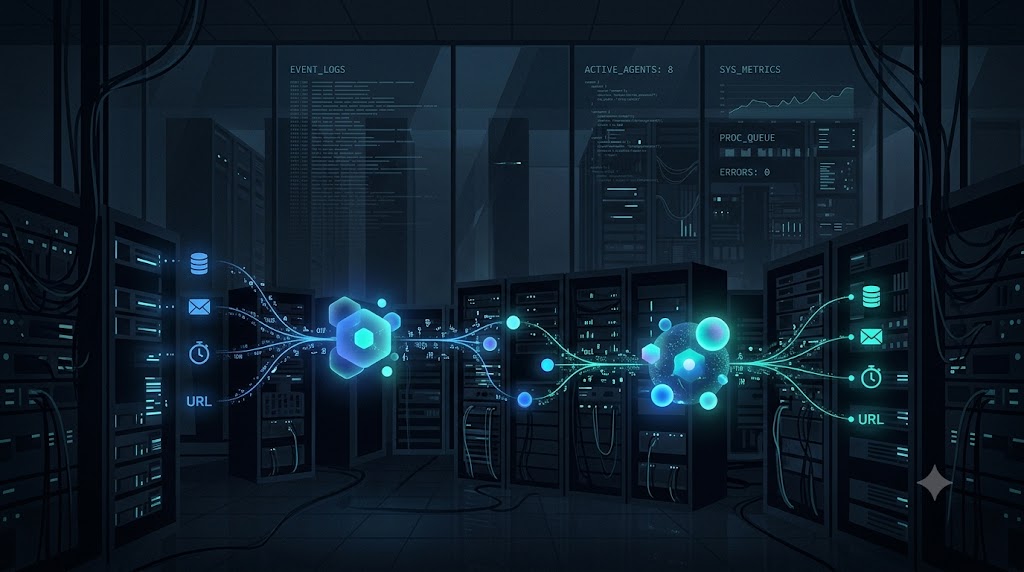
There’s another category of agent — one that has no chat interface at all. No human types a prompt. No human reads the output. The agent wakes up in response to some event, does its work, and disappears. I call these headless agents, and I think they’re going to be far more common in business and enterprise settings than their chat-facing counterparts.
What Triggers a Headless Agent?
A chat agent is triggered by a human’s input. A headless agent is triggered by something else. That “something else” is the interesting part:
- A new row is inserted into a database table
- A record is updated and crosses some threshold
- A message arrives in a queue
- A file lands in a storage container
- A scheduled timer fires
- An API webhook delivers an event
- Another agent hands off a task
In each of these cases, the agent wakes up, examines the situation, applies some judgement, takes some actions, and shuts down. No human in the loop. No chat window. No one watching in real time.
That’s a headless agent.
Why These Will Dominate in Enterprise
Think about the actual day-to-day work that happens in most business roles. Plenty of it is genuinely interesting and requires human creativity, empathy, and deep domain expertise. But some significant fraction of it is… not.
How many people have a valuable job, but also need to check a specific inbox every morning and route some emails? Or stop their real work a few times a day to fill out some paperwork, send some notifications, or update a spreadsheet that feeds into some downstream process?
These tasks often require limited, but some judgement. Enough that a hard-coded rule engine tends to fail. Not enough that they couldn’t be handled by an agent with a well-crafted directive and access to the right tools and data.
These are the low-hanging fruit of AI automation. Not replacing people’s entire jobs — replacing the repetitive, peripheral tasks that orbit around people’s actual work. The tasks that fragment focus, consume time, and produce nothing that requires a human.
In my view, this is where agents will have the most immediate and measurable impact in business and enterprise settings. And these are all headless agents.
Same Architecture, Different Trigger
A headless agent is still an agent. As I’ve described before, every agent is:
Agent = Harness + LLM + Directive
The Harness is the code that orchestrates everything — the loop, the tool calls, the context management. The Directive is the system prompt that shapes the agent’s behavior and scope. The LLM does the reasoning.
For a chat agent, the Harness receives user input and returns a response to a UI. For a headless agent, the Harness receives an event — a queue message, a database notification, a webhook payload — and acts on it.
Structurally, these are the same thing. The difference is what initiates the work and what happens with the result.
A headless agent’s Directive is often narrower than a chat agent’s. It doesn’t need to handle arbitrary conversational context. It has a specific job: when this kind of event arrives, here is how to handle it. That narrowness is actually a feature. A tightly scoped Directive means the agent is more predictable, more testable, and less likely to go off in unexpected directions.
Headless Agents Absolutely Require Observability
This is not optional.
With a chat agent, there’s a human in the loop. If the agent produces bad output, the human notices. They can ask a follow-up question, try again, or escalate. The human is the safety net.
With a headless agent, there is no human watching. Nobody sees the output until some downstream consequence reveals that something went wrong — maybe days or weeks later, maybe never in a way that’s attributable to the agent.
I’ve written about observability for RockBot, and everything I said there applies here — with even higher stakes. For headless agents, you need:
- Structured logging for every invocation. What event triggered the agent? What did it do? What tools did it call? What was the final output?
- Metrics on token consumption and cost. Headless agents can run at high volume. A bad prompt that causes looping or excessive LLM calls can silently burn budget before anyone notices.
- Latency tracking. If an agent is supposed to process events in near-real-time but its p95 latency is climbing, something is wrong with the pipeline.
- Failure alerting. If the agent fails to process an event — or processes it incorrectly — someone needs to know. Not eventually. Now.
Without these things, you’re running automation that nobody can see, that nobody can debug, and that nobody will notice is broken until the damage is already done. That’s not automation — that’s a time bomb.
The rule I’d apply: if a human used to do this task and would have noticed when something went wrong, your headless agent needs to be able to surface that same signal through instrumentation.
Where Headless Agents Run
Headless agents are event-driven by nature, which makes them a natural fit for event-driven infrastructure.
Azure Functions are an obvious choice. A Function can be triggered by a queue message, a database change, a blob arriving in storage, a timer, an HTTP call — basically everything on the list above. The Function runs, does its work, and shuts down. You pay for what you use, not for idle time.
KEDA (Kubernetes Event-Driven Autoscaling) is another option, particularly if you’re already running on Kubernetes. KEDA can scale your agent workloads to zero when there’s nothing to process, and back up when events start arriving. The same economic principle: no idle resource cost.
Other event-driven platforms — AWS Lambda, Google Cloud Run, and similar — all apply the same model.
The key property all of these share is that the agent doesn’t sit idle waiting for work. It responds to demand. This matters because the “running cost” of a headless agent that processes 10 events a day is dramatically different from a long-lived service that holds a connection open around the clock.
Headless Agents Are Still Connected
Being headless doesn’t mean being isolated. These agents use the same ecosystem as any other agent.
A headless agent can call MCP servers to query databases, update records, send notifications, call external APIs, or retrieve documents. It can use A2A (agent-to-agent) protocols to delegate sub-tasks to specialized agents. It can enqueue messages to downstream systems or other agents as part of its processing.
In a mature enterprise agent ecosystem, you’d expect to see headless agents passing work to each other via queues — one agent processes an incoming order event, enriches the data, and publishes a message that triggers another agent to run a credit check, which in turn triggers another agent to update inventory. Each agent has a clear, bounded responsibility. Each can be deployed, scaled, and monitored independently.
This is the agentic equivalent of a well-designed microservices architecture: loosely coupled, independently deployable, observable at every boundary.
Where This Is Headed
I have no doubt that headless agents will quietly become the most important category of AI deployment in business. Not because they’re flashy — they’re the opposite of flashy — but because they’re where the actual automation happens.
Chat agents are visible and immediate. They’re easy to demo and easy to understand. But the work that changes how a business operates happens in the background: processing events, making decisions, routing tasks, updating records — all the repetitive, judgement-light work that currently fragments so many people’s days.
When those headless agents are running well, nobody notices. The inbox gets processed. The notifications go out. The spreadsheet gets updated. People get their time back.
When they’re running poorly — or not at all — somebody definitely notices. Which is exactly why observability isn’t an afterthought for these systems. It’s the whole game.
If you’re thinking about where AI agents can make a real difference in your organization, I’d encourage you to look past the chat interface. Look at the event-driven work that’s happening every day. Look at the peripheral tasks that fragment your team’s focus. That’s where headless agents belong.
This post was authored with the assistance of AI.