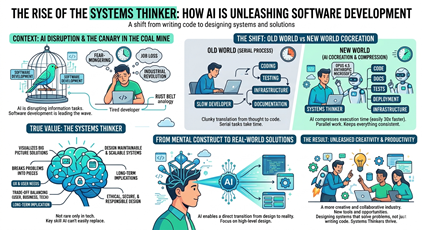
AI is going to disrupt any work that involves sitting at a computer screen or dealing with information: software development, accounting, marketing, legal work, and much more. Some of the concerns about this are extremely valid — I worry that our politicians, business leaders, and social leaders aren’t ready to help us navigate changes on the scale of the Industrial Revolution, or at least the factors that led to the US Rust Belt. But I’m also optimistic that the long-term result has the potential to be positive.
I’m not an economist, so I’m going to stay in my lane: software development. Our industry is a canary in the coal mine, because we’re building the tools that will disrupt those other industries. And when I say “the software development industry,” I mean everyone who writes software — whether they sit in a healthcare company’s IT department or at a software vendor.
I’m already at the point where I don’t manually write any code anymore. When Opus 4.5 came out in November 2025 it changed the world, and between the models and tooling available from Anthropic and Microsoft, I have learned how to co-create software with AI.
Not just the code itself, but deployment, infrastructure, devops pipelines, unit testing, some user acceptance testing, documentation — all of it. And I can do it faster and better than before.
How much faster? Easily 30 times. A feature that used to take me two weeks of serial work — write and test the code, figure out deployment, get user feedback, write the docs — now comes together in a single day. The code, documentation, deployment scripts, and tests are all created in parallel, with the AI helping keep everything consistent.
I do still look at code! I do review some of the pull requests, and I watch what the AI does so I can help it stay focused and on track. But I don’t write or edit code, I simply tell the AI to update code, docs, devops pipelines, etc.
So if a software developer or software engineer no longer writes code, or sets up infrastructure, or all the other things on which we used to be measured, what does that mean for the software development industry?
To answer this question, we need to do some introspection. What is the real value that a software developer/engineer/architect provides?
Was it that we can type fast? No. Was it that we learned esoteric programming languages and frameworks? No. Was it that we could write code that was efficient and performant? No.
We are systems thinkers. At least good developers are.
What does that mean? A systems thinker can take a problem, decompose it into smaller pieces, and figure out how to solve those pieces in a way that fits together to solve the larger problem. More specifically, systems thinkers:
- Design systems that are maintainable, scalable, and resilient
- Think about user experience and build software that meets real needs
- Navigate trade-offs between users, business goals, and technical constraints
- Consider the long-term implications of design decisions
- Account for ethical concerns: inclusivity, accessibility, security, privacy, and transparency
My observation, after almost 40 years in the software development industry, and working across many different vertical industries, is that most humans are not systems thinkers. Sadly, this includes quite a few “coders” and “programmers” and other labels people hold within the software development industry.
And this skill isn’t unique to our industry. My neighbor is a carpenter and contractor, and he’s absolutely a systems thinker. He juggles building codes, client budgets, subcontractor schedules, material lead times, and long-term maintenance — all while keeping the homeowner’s vision intact. Different domain, same mental discipline.
Systems thinking is the skill that lets us build software that actually works for users, businesses, and the long haul. It is the critical skill for software developers.
I argue that this is one of the key skills that, in the foreseeable future, will not be easily replaced by AI.
In fact, I’m using these skills more than ever, because the rest of the work is highly compressed by AI. The cycle time between idea and implementation is now so short that I have to think about the system as a whole — how all the pieces fit together — in order to keep up with the pace of development. All day, every day.
This reminds me of a scene in the radio play Ruby 3 where characters create elaborate constructs purely in their minds. I’ve always found that to be a powerful metaphor for what we do as software developers: we build the system in our heads first, and then we make it real.
Writing code was the clunky way we had to translate these beautiful constructs in our minds into something that a computer could understand. Now, with AI, we can directly translate those constructs into software, without having to go through the clunky process of writing code.
At least that’s where I think we are headed - rapidly.
So yes, AI will entirely disrupt the software development industry. But I think it will actually unleash the creativity and productivity of systems thinkers: people who can take a business problem, visualize the system and solution in their minds, and work with AI to turn those mental constructs into software that has a tangible effect in the real world.
The industry is shifting from writing code to designing systems. If you can hold a complex system in your head and guide AI to build it, you are more valuable than ever. The question for every developer is: are you a systems thinker, or are you a typist? Because AI already types faster than any of us.